
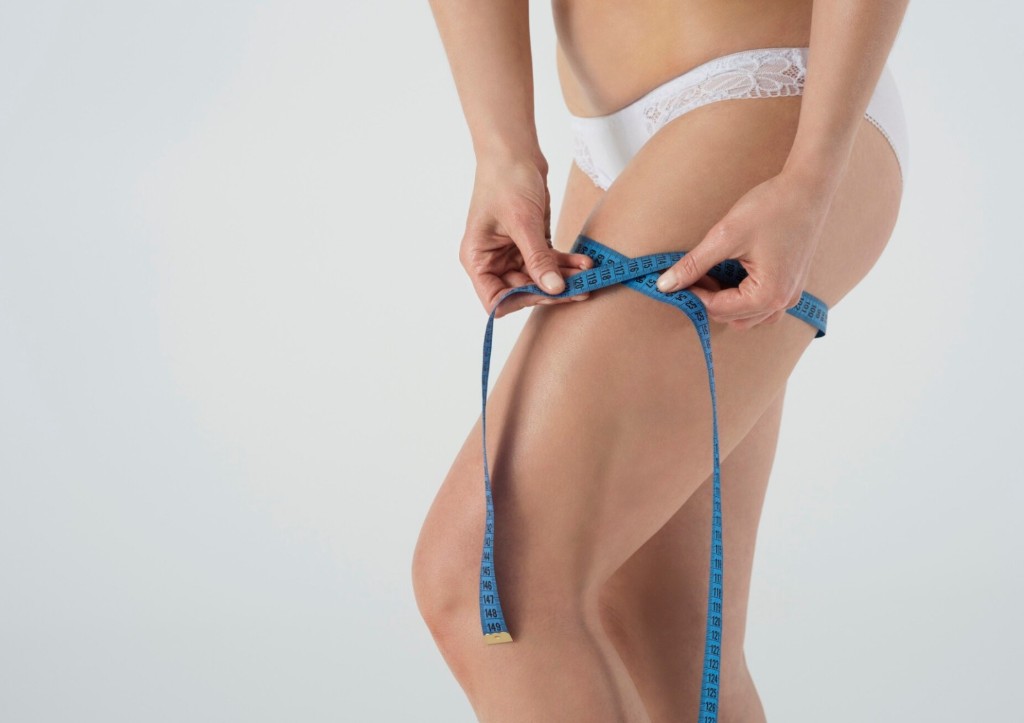
What does leg slimming mean for your goal?
For one person, the concern is inner-thigh fullness; for another, it is loose-looking skin or how clothing feels. You can begin a consultation by saying you want slimmer legs, but describe the change you hope to discuss more precisely.
Non-invasive body contouring is not a weight-loss or obesity treatment. The FDA notes that the intended effect may not always be achieved and some effects may be temporary. [1] Do not evaluate a proposed procedure by an expected change on the scales.
Inner thighs touching does not by itself create a need for a cosmetic procedure. Rather than using a social-media photograph as a standard, discuss your own goal and the limits of the proposed plan. Choosing not to proceed is also valid.
The earlier regional slimming guide explains the distinction between contouring and weight loss. This article applies that discussion specifically to the inner-thigh area.
How do fat, loose skin and swelling differ?
Start by describing what concerns you: fullness in a particular area, folds of skin, surface dimpling or swelling that changes during the day. These descriptions are not diagnoses; they help identify the questions an examination should address.
The American Society of Plastic Surgeons notes that people with loose skin or poor skin tone may not be suitable candidates for cryolipolysis. Reducing a fat bulge and addressing loose skin should not be treated as identical goals. [3]
Swelling needs separate consideration. The NHS explains that fluid accumulation can cause oedema in the legs. [7] A short-term change in circumference therefore should not automatically be interpreted as fat loss.
If surface dimpling is your main concern, the earlier cellulite appearance article can help distinguish the terminology. If you have several goals, ask how each will be assessed separately within the proposed plan.
Do inner-thigh exercises guarantee local fat loss?
No. Exercising an area does not guarantee that fat will be lost from that same location. A small 2013 study involving 11 participants found no significant fat reduction in the trained leg after 12 weeks of one-leg resistance training. This limited study does not represent every exercise programme, but it does not support a promise that the exercised area will necessarily lose fat. [5]
That is not a reason to dismiss exercise. Separate your exercise goals from expectations about a cosmetic change. Do not treat an online movement routine as a guarantee of rapid inner-thigh fat loss. Discuss an appropriate activity plan with a relevant health or exercise professional, taking your health into account.
It may also help to track what matters to you beyond a tape measurement. Write down whether your priority is clothing fit, comfort during movement or appearance. That gives you a clearer reference than changing advertising promises.
How should localised procedures be compared?
Before considering a procedure, ask which tissue and appearance it aims to address. Cryolipolysis is a cooling-based approach intended to reduce a localised fat bulge. [3] Devices using heat or other forms of energy have their own intended uses and safety conditions. [1]
The following table is a consultation aid rather than a ranking of methods. It helps connect a described concern with the question that needs an answer.
| Concern described during consultation | What needs clarification? | Question before a procedure |
|---|---|---|
| Fullness in a particular inner-thigh area | The precise area being assessed | Why is this device proposed for this area and goal? |
| A firmer-looking appearance | Volume and loose skin considered separately | Which change does the plan target, and which does it not address? |
| Surface dimpling | Skin-surface appearance as a separate goal | Will assessment rely only on circumference? |
| Swelling that changes during the day | The cause of the swelling | Is medical assessment needed before cosmetic treatment? |
| Marked excess tissue | The limits of a nonsurgical approach | Would another specialist assessment be appropriate? |
The American Academy of Dermatology describes nonsurgical fat reduction results as more subtle than those of liposuction. [2] Surgical and nonsurgical procedures should not be presented as different prices for the same outcome.
Do not assume that every procedure raised in a consultation checklist is offered by Termal Şok. The specific service being proposed must be explained separately.
Swelling, bruising and discomfort can occur after nonsurgical fat removal. [2] Alongside possible side effects, ask who would assess a problem. If you are considering a cooling-based procedure, the earlier cryolipolysis risks guide can help you prepare for the safety discussion.
How should CryoSlimming be assessed for the inner thighs?
Termal Şok's CryoSlimming service page describes a regional body-care approach involving warm and cold applications and mentions the legs. This description does not establish suitability for every individual's inner thighs or prove a particular outcome. [6]
A general statement that a service can involve the legs is not personal clearance. Ask for the actual device manufacturer and model, the areas covered by its instructions, who will carry out the procedure and who is responsible for assessment.
Research into generic cryolipolysis should not automatically be treated as evidence of equivalence for CryoSlimming. The earlier cryolipolysis and CryoSlimming comparison explains this distinction. Claims of greater effectiveness or safety require relevant device and protocol information.
Which symptoms should prompt medical assessment first?
The NHS describes lipoedema as potentially involving disproportionate enlargement on both sides, with pain, tenderness, heaviness and easy bruising. These features do not establish a diagnosis by themselves; request medical assessment if they apply to you. Do not choose cosmetic contouring on the assumption that it treats lipoedema. [4]
Unexplained swelling in one leg, sudden swelling or painful swelling warrants prompt medical assessment. Seek emergency care if leg swelling is accompanied by breathlessness or chest pain. [7]
Share a known circulation or lymphatic condition, cold-related illness, medication and previous procedures during your consultation. This article cannot provide treatment clearance. Individual assessment and the actual device instructions must guide suitability decisions.
How should sessions, follow-up and cost be discussed?
There is no session count that answers every request for leg slimming. Try to leave the consultation with a written initial plan: which area was assessed, what the intended goal is and when reassessment will take place.
Ask for records of the same area under comparable conditions. Check whether the photograph angle, posture or measurement point has changed. A single before-and-after photograph or one day's tape measurement should not be treated as a complete assessment of the outcome.
The American Academy of Dermatology explains that changes after device-based fat removal develop gradually. [2] This general information does not set a personal waiting period or schedule for your device. Ask how the proposed review timing applies to your plan.
For a quote, clarify whether both legs are counted together or separately and whether review appointments are included. The earlier body contouring prices guide explains how to compare the scope of offers.
How can you prepare for a consultation?
Write a short description of the area and change you want to discuss. Include the dates of previous procedures in the same area and any problems afterwards. Describe symptoms such as changing swelling rather than grouping everything under leg size.
Four useful questions are:
- What assessment is needed for the appearance I have described?
- Which expectations would the proposed plan not address?
- How will I learn about side effects and the contact route if a problem occurs?
- How will decisions to continue, pause or avoid treatment be made?
Use the Termal Şok contact page to ask about an initial discussion of service scope. The purpose is to understand appropriate options and their limits, rather than to buy a guaranteed leg shape or a promised loss of centimetres.