
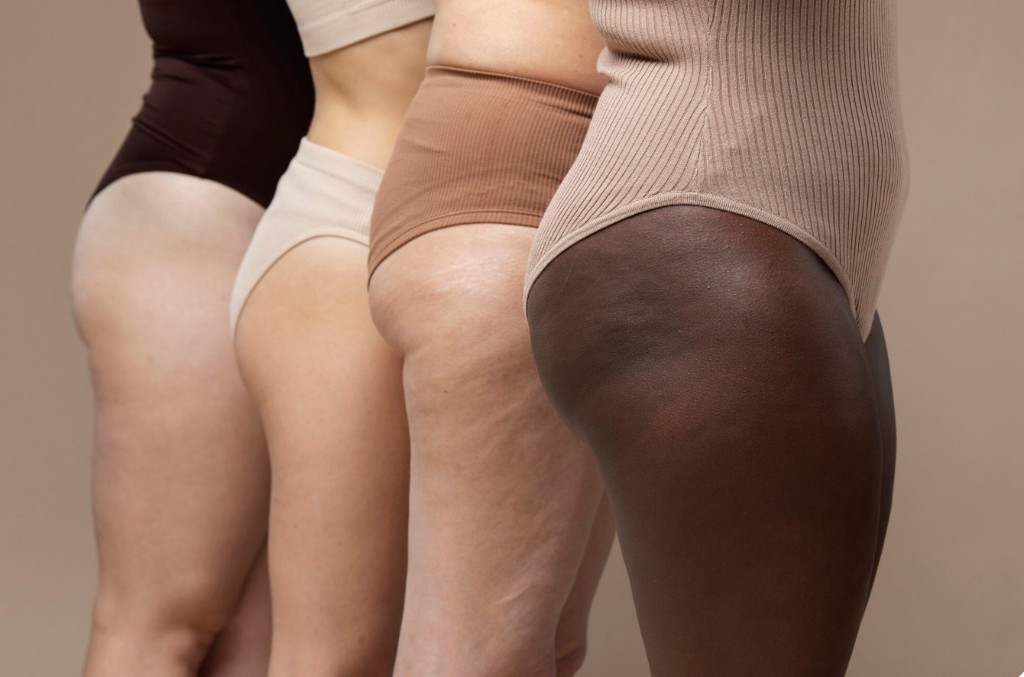
What is the appearance of cellulite?
Cellulite describes a dimpled or uneven skin surface, commonly seen around the buttocks and thighs. It is often called an orange peel texture. Lean people can have cellulite too, and cellulite itself is not considered harmful to health. [1]
When researching this appearance, your first question does not have to be which procedure will make you lose weight. If surface irregularity is your concern, make that the focus of the consultation. Having several concerns in the same area does not mean they will be addressed with the same method or assessed in the same way.
Having treatment is a personal choice. You can discuss your current appearance and expectations without making the smooth skin in someone else's photograph a compulsory goal. The purpose of researching options is to make a better-informed decision, rather than to treat every difference in your body as a problem.
What causes cellulite?
The relationship between connective tissue and fat
Fibrous bands connecting the skin to deeper tissue can pull down at certain points while the fat between them presses outward. This interaction can create surface dimpling. Mayo Clinic explains cellulite through this relationship and notes that its causes are not fully understood. [2]
This explanation helps show why an assessment based only on excess fat can be limited. Ask for the skin's surface appearance to be considered alongside the amount of fat. A treatment promoted for reducing the size of an area does not, by that description alone, explain whether it will address dimpling.
Genetics, hormones and age
Genetic characteristics, hormonal factors and changes in skin elasticity with age can play a role in cellulite appearance. It is more common in women. [2] Two people following the same care routine can therefore have different skin appearances.
Focus on your own starting point rather than building your expectations around another person's session count. Knowing which device or package someone else used may be useful background, but the reasons for the plan proposed for you should be explained separately. Make a note of how long you have noticed the appearance and which treatments you have tried before.
Are cellulite, localized fat and loose skin the same?
These terms may appear together, but describe them as separate goals at the consultation. Wanting less dimpling on the skin's surface is different from having localized fullness assessed. The American Academy of Dermatology specifically notes that a treatment which reduces fat does not necessarily improve cellulite. [3]
| Main concern | How you might describe it | Question to ask |
|---|---|---|
| Cellulite appearance | Dimples or uneven texture on the skin's surface | How does the proposed method address surface appearance? |
| Localized fullness | An area with a fuller-looking outline | Is the goal to assess the contour of this area? |
| Loose-looking skin | Skin that appears loose or sagging | What assessment is needed for the appearance of firmness? |
| Several concerns | More than one expectation in the same area | Which goal comes first, and how will each be assessed separately? |
If you also want to understand the difference between localized shaping and weight loss, read our body contouring guide. The purpose of this distinction is to help you start your care research with the right question.
How can you describe cellulite on your thighs?
Adding detail to “I have cellulite on my legs” makes a consultation more informative. Which area do you mean: the front, back or outer thigh, or the area close to the buttocks? Are you mainly concerned about individual dimples, a generally uneven surface or loose-looking skin?
Rather than starting with a request for completely smooth skin, identify the particular area you would like assessed. In your notes, include when you first noticed the appearance, previous procedures and your observations about them. These descriptions do not replace a diagnosis; they provide a starting point for the conversation.
A photograph of the whole leg and a close-up of one area provide different information. If you use an image to explain your concern, indicate which part you mean. Complete the assessment with an appropriate examination or consultation rather than turning a photograph into a promise of results.
What targeted body care options are available?
Daily skin care and cosmetic products
The scope of research on creams and lotions is limited. Some products may affect appearance, but they should not be treated as solutions that remove the entire underlying structure of cellulite. The AAD notes that effects and tolerability can vary between products. [3]
When choosing a product, learn about its ingredients, instructions and suitability for your skin. A label such as “firming” or “anti-cellulite” does not, by itself, establish the size or duration of an expected change. Rather than starting several new products together, record what you started and when so you can describe your experience more clearly.
Massage and mechanical treatments
Massage or vacuum-based devices may feature prominently in your research into targeted body care. Mayo Clinic notes that changes from these approaches may be short-lived. [4] It is useful to discuss an immediate sensation or appearance separately from a longer-term assessment.
Ask what the proposed application targets, where it will be used and how its effects will be followed up. Request the device name and protocol rather than accepting a general description such as having a massage. Your comfort, possible side effects and whom to contact afterward should also be part of the discussion.
Energy-based treatments and medical procedures
Radiofrequency and some laser applications are among the options discussed for cellulite appearance. Procedures such as subcision, which target connective tissue bands, are a separate group involving treatment beneath the skin. The ASDS distinguishes between their purposes and how they are performed. [5]
Do not treat all these approaches as interchangeable packages under the heading of body care. Find out which involves a medical procedure, who performs it and why it is being proposed for you. Discussing these methods here does not mean Termal Şok offers all of them; visit the treatments page for its current options.
Where do CryoToning and CryoSlimming fit into the assessment?
The Termal Şok website presents CryoToning with a focus on the appearance of firmness and toning in loose-looking skin. CryoSlimming is described with a focus on localized contouring and fullness using warm and cold applications. [8, 9]
If skin surface dimpling is your priority, say so explicitly. When asking about CryoToning, find out what change could be considered for that particular goal. If localized fullness is also present, ask separately why CryoSlimming is being proposed and which goal it is intended to address.
Conventional cryolipolysis is used for fat reduction; the AAD does not recommend it as a method for eliminating cellulite. [3] Do not therefore assume that all devices using cold are equivalent or that results from another device establish evidence for Cryo T-Shock. Distinguish general information about a technology from the evidence for a specific device.
What role do exercise and weight management play?
Regular activity is important for general health. The World Health Organization recommends 150–300 minutes of moderate-intensity activity per week for adults, along with muscle-strengthening activity on at least two days. These are general health recommendations, not a guarantee of a cellulite-related outcome. [6]
Mayo Clinic notes that activities which work the muscles may help improve skin appearance. [4] Discuss walking, swimming or other activities you enjoy as part of a routine that suits you. Rather than building your activity goals only around pressure to change one aspect of your skin, consider a routine you can maintain.
If your weight changes during a care plan, share this at the follow-up appointment. This makes the circumstances behind comparisons between different records clearer. Where an individual nutrition or activity plan is needed, work with appropriate healthcare professionals. This article does not provide a weight-loss program.
How can you follow up on results?
If the target of your cellulite assessment is the skin's surface, discussing circumference measurements alone does not provide a complete framework. Lighting and posture affect photograph comparisons. A scientific review highlights the importance of consistent conditions in baseline and follow-up photographs. [7]
At the consultation, ask how the following will be recorded:
- A clear description of the target area and the starting date.
- Photographs taken with similar distance, angle, lighting and posture.
- Session dates and the method applied.
- Any weight changes during the process.
- A planned review date and the criteria used for assessment.
A change in a photograph does not, by itself, establish its cause. Consider the application, timing and your expectations together at review. Asking at the start when the plan will be reassessed is more informative than expecting a definite result immediately after every session.
What should you ask before choosing targeted body care?
If you are researching a package intended to reduce the appearance of cellulite, go beyond learning its name. Ask which device will be used, about the practitioner's relevant training, how the assessment is performed and why the treatment is proposed for your goal. If several methods are offered, find out the role of each in the plan.
Discuss the length of a session, the overall appointment schedule and follow-up separately. A quotation should clearly identify the areas and services included. Clarifying the scope of phrases such as “full legs” or “full body” makes different offers easier to compare.
You should also be told what effects may be expected afterward and whom to contact if a problem occurs. The FDA explains that non-surgical body contouring devices have risks and that these vary by technology. [10] Share your health history and learn how your suitability for the proposed application will be assessed.
When is a medical assessment needed?
The appearance discussed in this article is cellulite, a cosmetic skin concern. Cellulitis is a different condition: a skin infection. If an area becomes painful, hot and swollen, do not assume it is simply cosmetic cellulite; seek prompt medical assessment. [11]
If you are planning a care appointment while experiencing a new symptom, address the health assessment first. Researching appearance-related care should not delay evaluation of an infection or another health concern.
Explore targeted body care with Termal Şok
When researching cellulite appearance, clearly identify your own goal: surface dimpling, loose-looking skin or localized fullness. This distinction helps you understand the purpose of a treatment when it is proposed.
You can explore Termal Şok's body care options and share your questions about CryoToning and CryoSlimming through the contact page. Discuss your expectations, the suitability assessment and follow-up plan at your initial consultation.
This article provides general information and does not replace an individual medical assessment.