
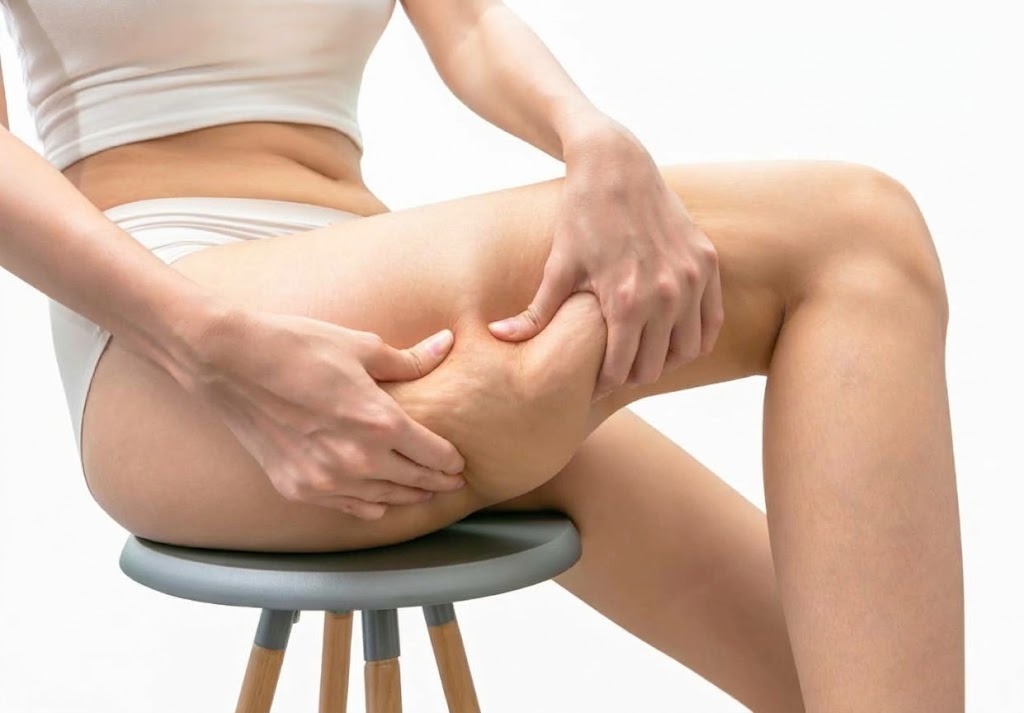
Where should you start when choosing cellulite treatment?
If cellulite appearance concerns you, begin by describing the area and change you want assessed. Wanting slimmer legs is different from wanting less noticeable surface dimpling. Explain both separately if you have both goals.
The appearance alone does not mean you need a procedure. You can attend a consultation simply to learn about options and limitations. Choosing not to proceed is also part of the decision.
The earlier cellulite appearance guide discusses causes and basic distinctions. This article focuses on assessing a proposed plan, session scope and outcome tracking.
Why separate cellulite, local fat and loose skin?
The AAD distinguishes cellulite from local fat and notes that reducing fat may not affect cellulite. [1] A statement that a procedure “targets fat” therefore does not establish that your surface-appearance goal has also been assessed.
Mention any separate concern about loose-looking skin. Circumference, surface dimpling and skin laxity should not share one outcome measure. Ask which goal each proposed stage addresses.
For example, after identifying the hip area, explain whether outer-thigh fullness or surface appearance is your priority. The hip and outer-thigh contouring guide can help you define the area.
Which treatment groups are being researched?
A 2023 review discusses products, massage, energy-based devices and procedures such as subcision as distinct groups. [6] These are not one protocol. Learning about them does not establish that every option is available at a particular centre or suitable for you.
Ask for the full device and method when encountering acoustic-wave, RF or laser names. Subcision is a medical procedure addressing bands beneath the skin. [6] Do not equate it with surface care or massage; request scope and risk information from the treating clinician.
The following table is not an effectiveness ranking. It identifies information needed to compare offers.
| Method or service group | Information to clarify | Main question before deciding |
|---|---|---|
| Products and daily care | Intended appearance change and use conditions | How are the expected effect, follow-up and skin suitability explained? |
| Massage or vacuum-based care | Actual system, area and scope | Does the evidence match this system? |
| Acoustic wave / RF / laser | Full device model and protocol | Does research assess the same device, area and goal? |
| Medical procedures such as subcision | Treating clinician, scope and recovery | How were personal risks and alternatives assessed? |
| CryoToning / CryoSlimming consultation | The goal behind the recommendation | Will surface appearance and local fullness be followed separately? |
Do not assume that all these options are offered at Termal Şok. Different procedures may share a broad name, so ask for device and protocol details alongside the package name.
How should you assess scientific evidence?
“Scientifically researched” does not explain the actual procedure proposed to you. Ask about the study's device, area, participant count, comparison group and follow-up. Find out whether the outcome was assessed using photographs, a rating scale or circumference.
A 2024 systematic review reports methodological quality concerns in studies of electrophysical cellulite approaches. [3] This does not establish that every procedure is ineffective; outcome and superiority claims need to be considered alongside study quality.
Do not treat one person's satisfaction or photograph as equivalent to clinical effectiveness. Ask whether other procedures, weight changes or different photography conditions affected the example. A single example does not guarantee your result.
What should a session plan include?
Ask how many sessions are proposed together with questions about goals and review. The area, scope of one session and first review date should be explained. A standard package count does not replace a personal plan.
A programme should define the baseline record, procedure stages and reassessment date. Find out when the plan might change and how to proceed if expectations are not met. The same session count does not imply the same outcome for everyone.
Request a separate rationale if several methods are proposed. Ask how the combined plan would be assessed against a single-method approach. More procedures or a higher fee do not independently establish stronger evidence.
How should outcomes and lasting effects be tracked?
Comfort after a session, skin appearance and longer-term change are different observations. Find out which will be assessed at review. Do not interpret a first-day photograph as proof of a lasting result.
Photographs should use consistent posture, relaxed muscles, lighting, distance and angle where possible. Ask whether images were retouched and whether the same area is being compared. Circumference alone does not measure the surface appearance of cellulite.
The FDA notes that some body-contouring effects may be temporary. [2] Discuss follow-up duration, possible maintenance and when changes will be reviewed. Ask which records support any lasting-results claim.
How should you discuss CryoToning and CryoSlimming?
Termal Şok presents CryoToning around a firmer, toned appearance and CryoSlimming around local fat and body contouring. [4][5] These descriptions provide starting goals for a consultation rather than individual outcome guarantees.
When researching cellulite treatment, ask how the proposed service relates specifically to surface appearance. Do not assume research on another device or protocol establishes the same outcome for this service.
The CryoSlimming and CryoToning comparison guide can help you prepare questions. Request separate expectations and follow-up measures for local fullness, loose skin and cellulite.
Does cryolipolysis address the same goal?
The AAD does not recommend cryolipolysis for removing cellulite. [1] This matters when separating fat reduction from surface appearance. The actual CryoSlimming device and protocol should not automatically be equated with conventional cryolipolysis either.
The cryolipolysis and CryoSlimming comparison guide explains this distinction further. Ask how closely general technology information matches the procedure proposed to you.
Suitability and risk discussion
The FDA explains that body-contouring risks vary by technology. [2] Nonsurgical does not mean risk-free. Current device instructions and individual assessment should guide the decision.
Share medication, previous procedures, pregnancy or breastfeeding status, unusual reactions to warmth or cold and wounds in the proposed area. Do not interpret pain, new swelling or another health symptom only as cellulite appearance; seek assessment.
Ask about expected effects, symptoms requiring the session to stop and the contact route afterwards. This article provides no instructions for setting device parameters or home temperature-and-duration programmes.
How should you compare cellulite treatment prices?
Ask separately about the price of one session and the total plan. One offer may cover one area while another covers both sides. Check whether assessment, review and additional procedures are included.
A written plan helps compare scope. Alongside session count, clarify the outcome and review date. A cheaper or longer package does not establish individual suitability.
Take these questions to the consultation:
- Is my priority surface appearance, local fullness or loose skin?
- What is the actual device and protocol?
- How does the evidence match the device, area and goal?
- When is the first review, and how is continuation decided?
- What are the total cost, alternatives and contact route for unexpected problems?
Explaining your expectations to Termal Şok
When contacting Termal Şok, describe the area and your surface-appearance goal. Mention separate expectations about local fullness or loose skin as well.
Compare the goal, evidence, suitability and follow-up together rather than choosing cellulite treatment from one device name or definite-results promise. A consultation explaining the options' limits helps you make a more informed decision.