
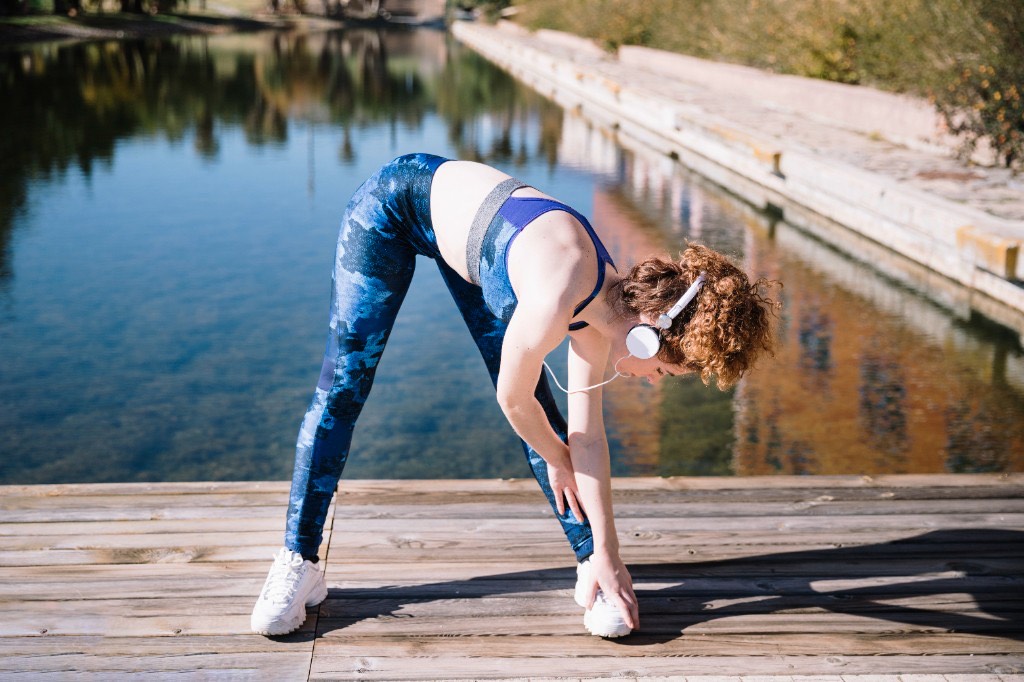
Exercises often described as hip fat loss exercises can strengthen the hip and leg muscles. Evidence does not show that squats, glute bridges or side leg raises reliably direct fat loss to the hips or outer thighs. Feeling stronger, changing body fat percentage and noticing a change in how the outer thighs look are separate outcomes. Decide which one you want to follow. [1, 2, 4]
Can hip fat loss exercises reduce fat only in that area?
The hips and outer thighs are the areas people often mean when they search for these exercises. You may feel muscle fatigue or a burning sensation while working the area. That sensation does not measure how much fat above the muscle changes. To evaluate targeted fat loss, researchers need to measure fat near the trained muscles over time.
A 2022 meta-analysis combined 13 studies involving training on one side of the body. The trained arm or leg did not show additional local fat loss compared with the other side. A small trial also found no significant fat reduction in the leg participants trained for 12 weeks. These findings do not support the expectation that working the outer hip reliably targets fat in that area. [1, 2]
A small 2023 trial in 16 men found a greater decrease in trunk fat with a specific abdominal endurance programme. It assessed the abdomen and a particular exercise protocol. It provides no direct evidence that hip exercises selectively reduce outer thigh fat. [3]
What do squats, glute bridges and side leg raises train?
Choose movements based on the muscles they work and the everyday activities you want to support. For example, someone who wants to rise from a chair more easily can track progress with a sit-to-stand movement. A study comparing weighted squats and hip thrusts observed glute muscle growth in both groups. That finding came from measurements of muscle growth. [4]
| Movement | Training focus | What you can track |
|---|---|---|
| Sit-to-stand or squat | Hip and front thigh muscles | Rising from a seat more comfortably and with control |
| Glute bridge | Hip extensors, including the gluteus maximus | Raising and lowering the hips smoothly |
| Side leg raise | Muscles that move the leg away from the midline | Completing the movement without swinging the trunk |
| Step-up onto a low, stable step | Hip and thigh muscles and control on one side | Feeling steadier when stepping up |
| Brisk walking | Aerobic endurance | Completing the same route more comfortably or sustaining the walk |
Start with a version you can do comfortably. Increase the challenge gradually as control improves. A programme that includes hip exercises can also train the upper body and the other major muscle groups. General adult activity guidance includes both aerobic and muscle-strengthening activity. [5]
How can walking and strength training fit together?
Brisk walking is one way to add aerobic activity to a routine. Strength training develops the muscles' ability to produce force. A review of studies in healthy adults found that resistance training could contribute to lower overall body fat percentage and fat mass. Those results describe changes across the body. They do not predict which region will change first. [5, 6]
Set the goal before deciding what to track. If you want to climb stairs more comfortably, observe your control on steps. If you want to walk for longer, track your time or how demanding a familiar route feels. You can record a goal about appearance separately from those measures.
What can you track alongside hip circumference?
If you track hip circumference, measure at the same point and under similar conditions. Look for a trend over time. A tape measure records the total circumference at that location and cannot separate changes in muscle from changes in fat.
For example, a sit-to-stand may become easier over several weeks even if the tape measurement stays the same. Improved control and a familiar walk that feels easier are also changes you can record. There is no universal timeline or centimetre target for a change in hip circumference.
For a guide to describing local fullness and contour goals, read hip and outer thigh fat reduction. The buttock firming guide covers the roles of muscle, fat and skin in more detail.